The bottleneck is no longer technical.
Knowledge now melts faster than organizations can re-bind it into identity, norms, and operating systems without depleting trust. What used to change across decades now changes across quarters. Under that pressure, the primary obstacle to progress stops being technical. It becomes cultural.
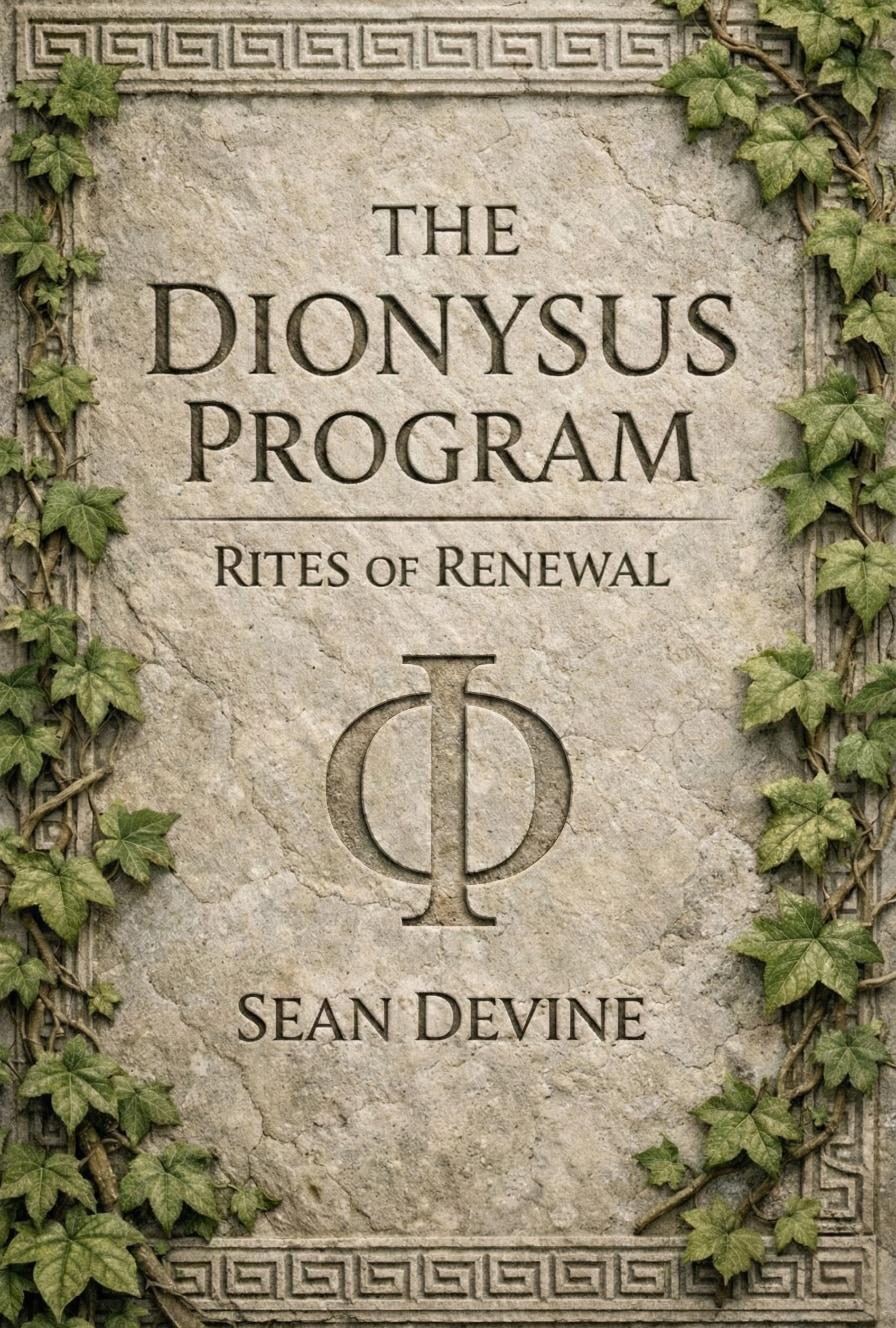
The Dionysus Program, written by Sean Devine, is the field manual for that bottleneck. It gives leaders language for what the organization is already feeling, a new scoreboard for whether learning is actually happening, and a method for converting error into new structure without collapsing into numbness, scapegoating, or management theater.
THE SCOREBOARD
Epimetabolic rate
The speed at which a person, team, or organization converts error into new structure without burning its social fabric.
THE TOGGLE
Run Time and Ritual Time
Ordinary execution and protected metabolizing are different modes. Confusing them is how organizations turn critique into theater or blame.
THE LOOP
Critique → dissolution → reconstitution → renewal
Not a slogan about candor. A loop you can actually run until truth gets cheaper, safer, and more productive.
The first move is being able to name what your organization is already feeling.
Without diagnostic language, leaders keep treating the symptoms as separate management problems and miss the common condition underneath them.
Anomie
The vacuum that forms when shared norms collapse and people can no longer tell what still holds.
Melt
The rate at which existing knowledge, roles, and structures decay under pressure and technical change.
Ren depletion
The thinning of relational density that makes truth telling, conflict, and change survivable.
The one-man job problem
When AI and distributed execution remove the collaboration that used to generate trust as a byproduct of work.
The program becomes useful when the distinctions start touching real decisions.
These are not ideas to admire separately. They are operating distinctions meant to work together under pressure.
Knowledge and myth run on different clocks.
Knowledge explains the world and decays as the world changes. Myth explains the person and the group. When leaders confuse the two, every technical change becomes an identity crisis.
The epimetabolic rate is the real scoreboard.
Velocity, margin, and throughput matter, but they are downstream. The governing question is whether the organization can turn error into stronger structure without tearing its social fabric.
Run Time and Ritual Time are different modes.
Execution mode cannot safely carry every kind of criticism. Some truth requires a protected container where performance scoring pauses and the group becomes accountable to the rite itself.
Ren is infrastructure, not a perk.
Trust is newly scarce under AI independence and distributed work. The program treats it as a prerequisite for high-heat truth telling, not as a soft byproduct that will somehow show up on its own.
The operator is inside the method.
A leader who cannot metabolize their own obsolescence cannot hold the container for anyone else. The quality of the transformation depends on the quality of the transformer.
Most organizations default to one of three bad responses.
The point of the program is not softer language. It is to avoid the familiar failure modes that show up when reality changes faster than the culture can digest.
01. Abdication
Pretend nothing fundamental is happening, defer the adaptation, and let time or competitors do the violence for you.
02. Coercive order
Force alignment through hierarchy and fear, push critique underground, and mistake silence for coherence.
03. Self-erasure
Ask people to absorb the loss privately, keep performing, and never tell the truth about what the change is costing them.
THE LOOP
The alternative is not softer. It is more structured.
The Dionysus Program replaces those failure modes with a loop: critique, dissolution, reconstitution, renewal. It concentrates conflict on shared objects instead of people, allows the old explanation to actually melt, and sends the organization back into execution with stronger structure and thicker trust.
Critique
Name the mismatch honestly and aim the conflict at the artifact, assumption, or rule instead of at a scapegoat.
Dissolution
Let the old explanation, identity claim, or operating assumption lose coherence instead of pretending it still works.
Reconstitution
Bind the learning into a new rule, container, commitment, or shared object the organization can actually carry.
Renewal
Return to Run Time with more reach, more honesty, and a lower cost for telling the truth next time.
The minimum viable program is deliberately practical.
This is not a methodology that requires a methodology to deploy. The point is to begin metabolizing while the error is still cheap.
01
Name the mode.
Say explicitly whether the room is in Run Time or Ritual Time before the meeting starts.
02
Cross every week.
Institute a regular crossing between execution mode and metabolizing mode so the shift is not reserved for crisis only.
03
Run tragic postmortems early.
Work the loss while the error is still cheap enough to teach, not after it has already hardened into folklore or blame.
04
Protect the cooling interval.
Do not demand instant emotional compliance after high heat. Restoration is part of the cultural metabolism, not a luxury after it.
05
Eat your decay.
Surface drift while it is still compost, not after it has become an identity-protecting crisis.
06
Make the rhythm fractal.
Repeat the same renewal pattern across the day, the week, the month, and the year so the loop becomes a system behavior.
This is the third layer of the same story, not a side philosophy.
XBE gives organizations a system of action. Agent XBE gives them a superworkforce. The Dionysus Program addresses what both do to roles, trust, and learning speed inside the company adopting them.
A stronger system makes more of the business legible. A superworkforce carries more of the work to the outcome. Both are real advantages. Neither solves the cultural bottleneck that appears when knowledge half-lives start collapsing and yesterday's role begins to melt under today's tooling.
That is why this sits inside XBE's message architecture. Not as a metaphor. As the next constraint that shows up once the system gets stronger and the superworkforce gets faster.
The system of action increases operational truth.
XBE connects planning, dispatch, field execution, materials, finance, and improvement so the business becomes more legible.
The superworkforce increases execution capacity.
Agent XBE carries clerical, analytical, and managerial work that would otherwise stall between insight and execution.
The cultural metabolism helps the organization absorb both.
The Dionysus Program addresses what that new power does to identity, trust, and the organization's ability to keep learning without burning itself down.
The full text is the product.
This page should orient you. The program site, book, and conversations carry the deeper architecture of the framework.
- Why knowledge and myth fail differently, and why that matters under accelerating change
- The epimetabolic rate as the governing diagnostic for organizational learning
- Run Time, Ritual Time, and the design of containers that can hold real heat
- The one-man job problem and why Ren has to be generated deliberately
- The longer architecture around rites of renewal, anti-scapegoat design, and organizational fate
OPEN BY DESIGN
Published in public
The program lives on its own site because it is meant to stand under reading, critique, and pressure in public, not hide inside a closed consulting deck.
If you want the conversational entry point first, start here. Some of these ideas land better when you hear them argued aloud.
Watch the conversation